
studio.heelab
[DL for CV] Image Classification with Linear Classifiers 본문
Lecture: https://www.youtube.com/watch?v=pdqofxJeBN8&list=PLoROMvodv4rOmsNzYBMe0gJY2XS8AQg16&index=2
1. Image Classification
The problem: Semantic Gap
An image is a tensor of integers between [0,255]
Challenges
-Viewpoint variation
-Illumination
-Background Clutter
-Occlusion
-Deformation

-Intraclass variation
An image classifier
def classify_image(image):
	#Some magic here:
    return class_label
Find edges -> Find corners
2. Data-driven Approach
3 Step Process
- Collect a dataset of images and labels
- Use ML algorithms to train a classifier
- Evaluate the classifier on new images
3. KNN (K-Nearest Neighbor) Algorithm
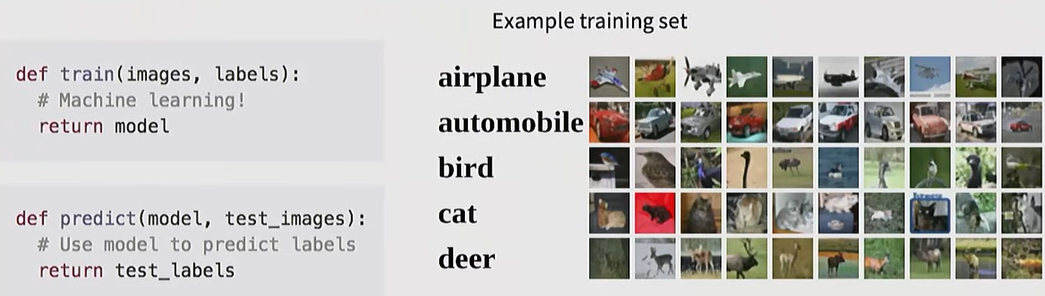
First classifier: Nearest Neighbor
-memorize all data and labels
def train(images, labels):
	#ML!
    retrun model
-Predict the label of the most similar training image
def predict(model, test_images):
	#Use model to predict labels
    return test_labels
Distance Functions
L1 (Manhatten) distance
-pixel-wise absolute value difference

L2 (Euclidean) distance

Hyperparameters
choices about the algorithms themselves
e.g. distance metric, K
Choose hyperparameters using the validation set
Only run on the test set once at the very end.
Setting Hyperparamters
Idea1. Choose hyperparameters tha work best on the training data
Idea2. Choose hyperparameters tha work best on test data
Idea3. Spilt data into train. val; choose hyperparameters on val and evaluate on test <- better idea

Idea4. Cross-validation: Split data into folds, try each fold as validation and average the results

Training is very fast O(1), but because it must compare with all data during prediction, the test speed is very slow O(N). Furthermore, distance calculation at the pixel level does not well reflect the semantic similarity of images.
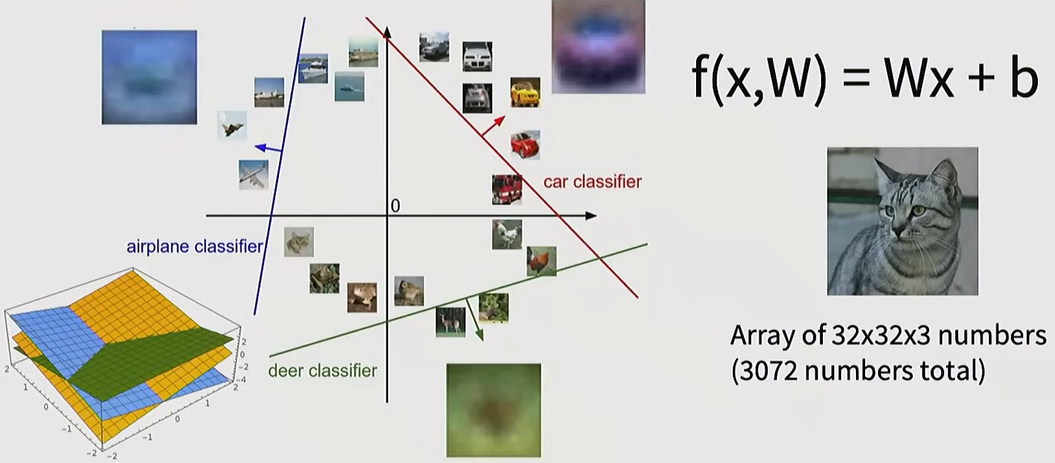
4. Linear Classifier
A parameter-based approach that maps the input image ($x$) to output class scores.
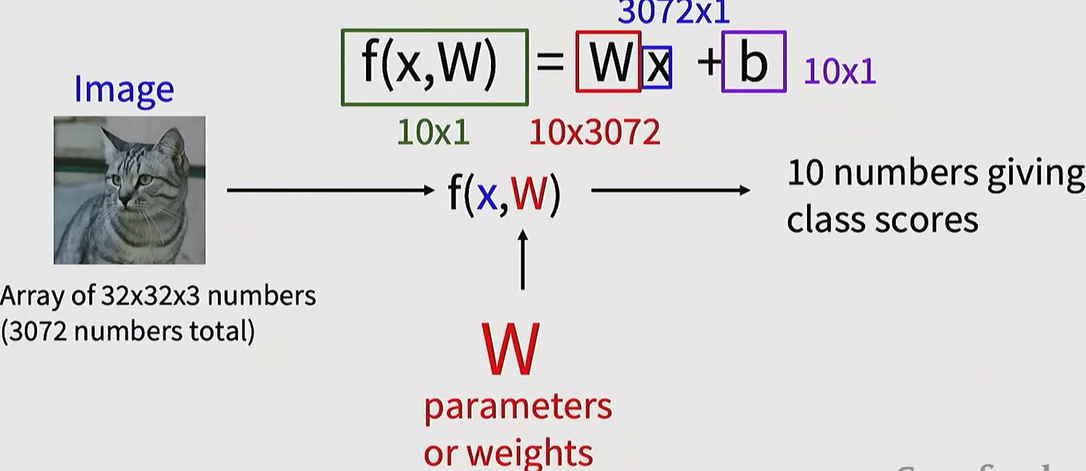
f(x,W)=Wx+b
W (Weights): weight parameters that must be found through the learning process.
b (Bias): bias values that adjust the preference for specific classes.
3 Perspective
1. Algebraic Perspective
Class scores are calculated through matirx multiplication
Input image -> vector
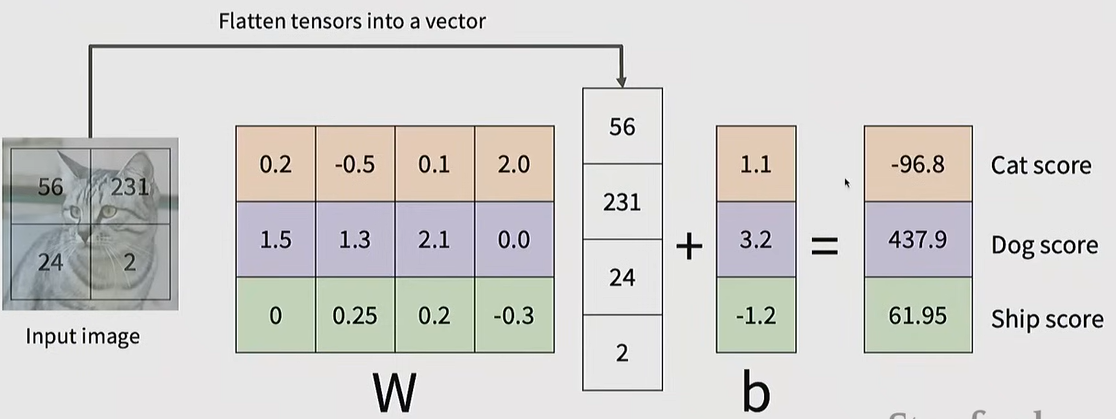
2. Visual Perspective
Each row of the weight marix W acts as a template for its corresponding class
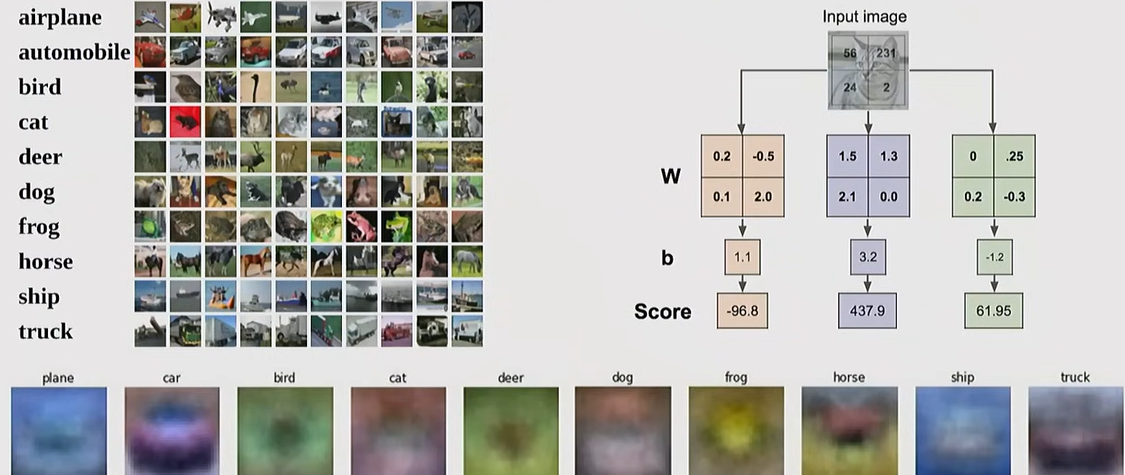
3. Geometric Perspective
It is equivalent to drawing decision boundaries (hyperplanes) that separate each class in a high-dimensional space
5. Loss Function and Softmax
Loss Function
A metric that quantifies how poorly the current classifier is performing (often referred to as "Unhappiness")
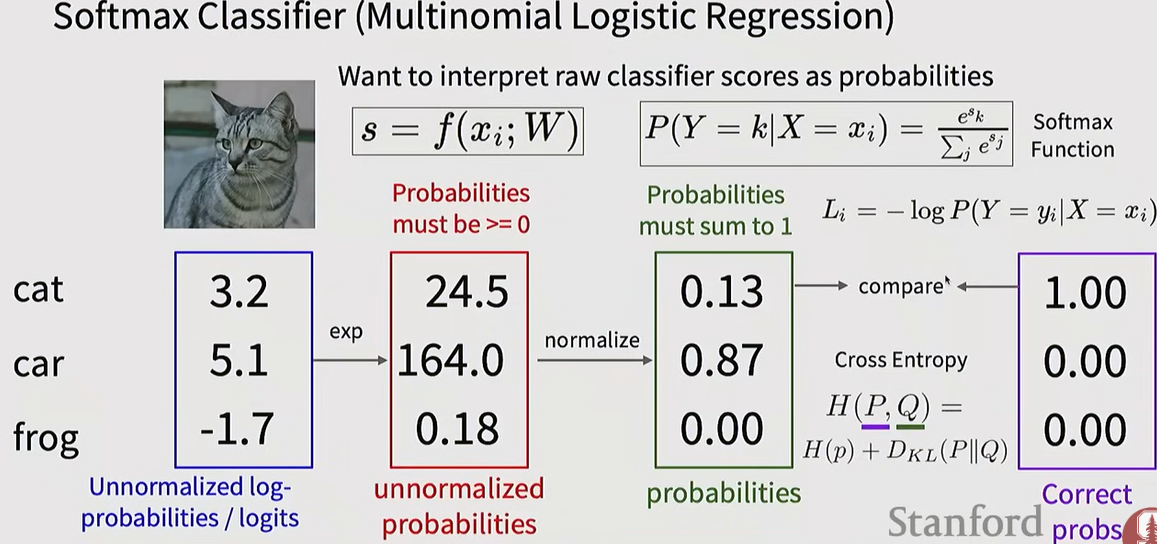
Softmax Classfier
It applies an exponential function to the output values (Logits) of a linear classifier and normalizes them into probability values between 0 and 1.
Cross-Entropy Loss
he goal is to minimize the negative log-likelihood of the probability corresponding to the correct class -log(P). This is equivalent to maximizing the probability of the correct class.
'MMAILab' 카테고리의 다른 글
| [DL for CV] Training CNNs and CNN Architectures (0) | 2026.03.05 |
|---|---|
| [DL for CV] Image Classification with CNNs (0) | 2026.03.05 |
| [DL for CV] Neural Networks & Backpropagation (0) | 2026.03.04 |
| [DL for CV] Regularization & Optimization (0) | 2026.03.04 |
| [DL for CV] Introduction (1) | 2026.03.04 |


